Learning how to improve off page SEO can feel confusing when you are new to search engine optimization. You may hear people talk about backlinks, guest posts, brand mentions, citations, reviews, and authority, but it is not always clear what actually matters.
Here is the simple version: off-page SEO is about building trust outside your website.

Your website content matters, but search engines also look at how other websites and people talk about your brand. In this guide, you will learn:
- What off-page SEO means
- Which off page SEO techniques are worth your time
- How to build authority without using spammy tactics
- How small businesses can improve rankings with practical steps
Let’s break it down in a clear, beginner-friendly way.
What Is Off-Page SEO?
Off-page SEO includes the actions you take outside your own website to improve your search visibility, authority, and trust.
It helps search engines understand that your business is credible. When trusted websites link to you, mention your brand, review your services, or list your business details, those signals can support your rankings.
Common off-page SEO elements include:
- Backlinks from relevant websites
- Brand mentions
- Guest posts
- Online reviews
- Local business citations
- Digital PR
- Social content promotion
- Podcast features
- Directory listings
- Industry partnerships
Think of off-page SEO as your online reputation. Your website says, “We are helpful.” Off-page SEO helps others confirm it.
Off-Page SEO vs. On-Page SEO
On-page SEO and off-page SEO work together, but they focus on different areas.
| SEO Type | Main Focus | Examples |
| On-page SEO | Improving your website pages | Keywords, headings, title tags, internal links, content |
| Technical SEO | Improving website performance | Site speed, mobile usability, indexing, structure |
| Off-page SEO | Building trust outside your website | Backlinks, citations, reviews, brand mentions, PR |
You need all three to build a strong SEO foundation.
For example, a great blog post may not rank well if your website has no authority. At the same time, backlinks will not help much if your content is weak or your site is difficult to use.
Micro-takeaway: On-page SEO makes your website relevant. Off-page SEO helps make it trusted.
How to Improve Off Page SEO With a Clear Strategy
The best way to understand how to improve off page SEO is to focus on quality over quantity.
You do not need hundreds of random backlinks. You need relevant signals from websites, platforms, and people your audience already trusts.
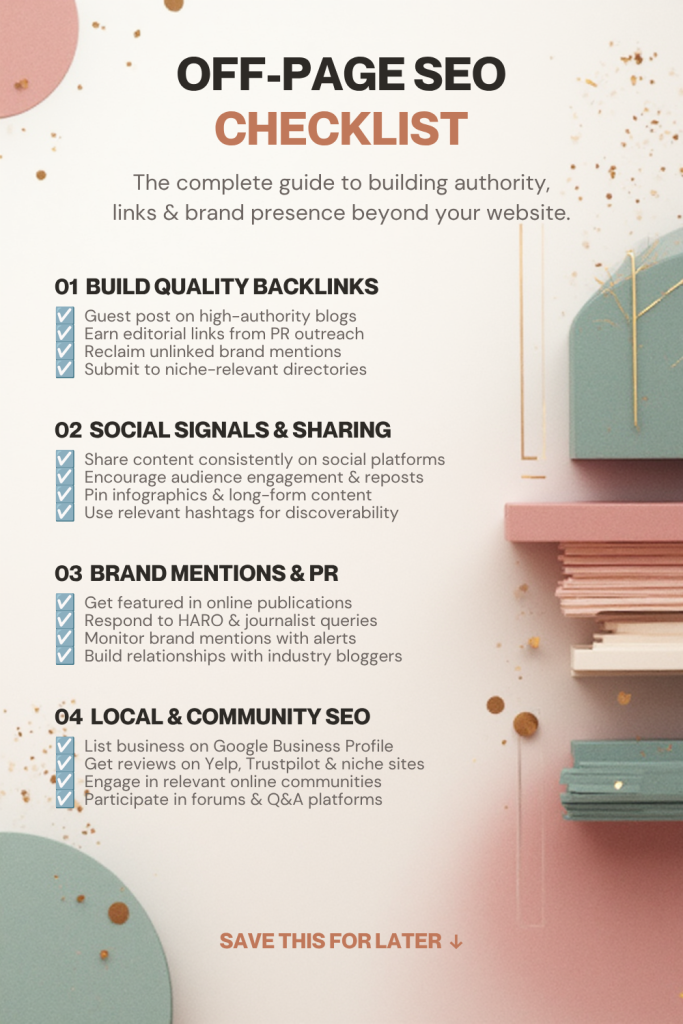
A strong off-page SEO strategy should include:
- High-quality backlinks
- Helpful, link-worthy content
- Guest posting on relevant websites
- Local citations
- Online reviews
- Brand mentions
- Digital PR
- Social promotion
- Industry relationships
- Competitor research
- Link monitoring
- Consistent improvement
Let’s go through each one.
1. Build High-Quality Backlinks
Backlinks are links from other websites to your website. They are one of the most important off-page SEO signals because they can show search engines that your content is useful and trustworthy.
But not every backlink is valuable.
A link from a respected industry website is far better than a link from a low-quality directory that exists only to sell links.
What Makes a Backlink Valuable?
A good backlink usually comes from a website that is:
- Relevant to your niche
- Trusted by real people
- Active and well-maintained
- Connected to your topic
- Not filled with spammy links
- Likely to send useful referral traffic
Practical Example
If you own a web design business, a backlink from a small business blog, local chamber of commerce website, marketing publication, or startup resource page can be useful.
A backlink from an unrelated website about gambling, fake products, or random coupons will not support your brand in the same way.
Micro-takeaway: One strong, relevant backlink can be more valuable than dozens of weak ones.
2. Create Content People Want to Link To
If you want more backlinks, give people a reason to link to your website.
Basic service pages are important, but they are not always link magnets. Helpful resources, original insights, and practical guides are more likely to earn links naturally.
Link-Worthy Content Ideas
You can create:
- Beginner guides
- Step-by-step tutorials
- Checklists
- Industry statistics pages
- Templates
- Case studies
- Local resource guides
- Comparison articles
- Expert roundups
- Free tools or calculators
Practical Example
A digital marketing consultant could create a post titled:
“Small Business Website SEO Checklist: 25 Steps Before You Launch”
This type of content is useful for business owners, designers, developers, bloggers, and agencies. That makes it easier to share and reference.
Micro-takeaway: The better your content solves a real problem, the easier link building becomes.
3. Use Guest Posts to Reach New Audiences
Guest posting means writing an article for another website in your industry or a related niche.
This can help you build authority, earn backlinks, and introduce your expertise to a new audience.
The key is to choose the right websites. Do not write for every site that says “submit a guest post.” Focus on platforms with real readers and relevant topics.
How to Find Guest Post Opportunities
Search for terms like:
- “write for us” + your industry
- “guest post” + your niche
- “contribute” + your topic
- “submit article” + your field
- “business blog guest post”
- “marketing guest contributor”
You can also look at where your competitors have published guest articles.
Guest Posting Best Practices
When pitching or writing a guest post:
- Choose a relevant website
- Pitch a specific topic
- Make the article useful, not sales-heavy
- Include examples and clear takeaways
- Link naturally to a helpful page on your site
- Build a long-term relationship with the editor or owner
Practical Example
If you offer SEO services, you could write a guest post for a startup blog called:
“7 SEO Mistakes New Businesses Make After Launching a Website”
Inside the article, you could naturally link to your SEO audit service or a related educational blog post.
Micro-takeaway: Guest posting works best when it helps the host website’s audience first.
4. Strengthen Local SEO With Citations
If you serve local customers, citations are one of the most practical off page SEO techniques.
A citation is an online mention of your business information. It often includes your:
- Business name
- Address
- Phone number
- Website
- Hours
- Services
- Business category
Citations help search engines confirm that your business is real and located where you say it is.
Keep Your NAP Consistent
NAP stands for:
- Name
- Address
- Phone number
Your NAP should be consistent across major directories and platforms. If your phone number or business name appears differently across the web, it can create confusion for both customers and search engines.
Citation Platforms to Consider
Depending on your business, you may want listings on:
- Google Business Profile
- Bing Places
- Apple Maps
- Yelp
- LinkedIn company page
- Local chamber of commerce websites
- Industry-specific directories
- Local business directories
Practical Example
A local SEO consultant in Austin should make sure their business name, address, phone number, and website are accurate across Google Business Profile, Apple Maps, Yelp, local directories, and relevant marketing directories.
Micro-takeaway: Consistent citations help customers find you and help search engines trust your business details.
5. Optimize Your Google Business Profile
Your Google Business Profile is one of the most valuable off-page assets for local visibility.
It can help your business appear in Google Maps, local search results, and “near me” searches.
How to Improve Your Google Business Profile
Make sure you:
- Choose the most accurate primary category
- Add relevant secondary categories
- Write a clear business description
- List your services
- Add your website link
- Upload quality photos
- Keep hours updated
- Add service areas if needed
- Post updates when relevant
- Answer common questions
- Respond to reviews
Practical Example
If you provide web design and SEO services, your profile should clearly show those services. Add descriptions that explain who you help, such as startups, local businesses, or personal brands.
Micro-takeaway: A complete Google Business Profile can improve local trust before someone even clicks your website.
6. Get More Reviews and Respond Professionally
Reviews help people decide whether to contact you. They can also support local SEO by showing that your business is active, trusted, and relevant.
For small businesses, reviews can be a major difference-maker.
Where to Collect Reviews
You may want reviews on:
- Yelp
- Trustpilot
- Clutch
- G2
- Industry directories
- Local marketplace platforms
Choose the platforms your customers actually use.
How to Ask for Reviews
Ask after a positive experience. Keep the request simple.
Example:
I’m glad you were happy with the project. If you have a minute, would you be willing to leave a quick review? It helps other business owners find my services.
Make it easy by sending a direct review link.
How to Respond to Reviews
For positive reviews:
- Thank the customer
- Mention the service naturally
- Keep it personal
- Avoid copy-paste responses
For negative reviews:
- Stay calm
- Acknowledge the concern
- Offer to continue the conversation privately
- Avoid arguing in public
Micro-takeaway: Reviews build trust with both customers and search engines.
7. Earn Brand Mentions
A brand mention happens when another website talks about your business, even if they do not link to you.
For example, your name might appear in a local business roundup, podcast notes, event page, or industry article.
Brand mentions help increase visibility and can support your authority over time.
How to Get More Brand Mentions
You can earn mentions by:
- Sharing expert opinions
- Joining podcast interviews
- Speaking at webinars
- Collaborating with local businesses
- Publishing useful resources
- Participating in community events
- Offering quotes for articles
- Creating original insights or reports
Turn Unlinked Mentions Into Backlinks
Sometimes a website mentions your brand but forgets to link to your site.
You can send a polite message like:
Thanks for mentioning my business in your article. I appreciate it. Would you be open to linking the mention to my website so readers can learn more?
This works because the website already knows who you are.
Micro-takeaway: Brand mentions create awareness, and unlinked mentions can become easy backlink opportunities.
8. Use Digital PR to Build Authority
Digital PR helps you earn online coverage from blogs, news sites, newsletters, podcasts, and industry publications.
It is one of the best ways to build backlinks and brand trust without relying on outdated link building tactics.
Digital PR Ideas for Small Businesses
You can pitch:
- Expert commentary on industry trends
- Local business stories
- Original survey results
- Case studies
- New service launches
- Community initiatives
- Founder stories
- Useful data or insights
Practical Example
A web design expert could pitch a topic like:
“What Small Businesses Should Fix on Their Websites Before Running Ads”
This type of insight can be useful to marketing blogs, business newsletters, and local publications.
Micro-takeaway: Digital PR works best when your story is helpful, timely, or interesting to a specific audience.
9. Promote Your Content Beyond Your Website
Publishing content is only the first step. You also need to help people find it.
Content promotion can lead to more traffic, shares, mentions, and backlinks.
Where to Share Your Content
Use platforms where your audience spends time, such as:
- X
- YouTube
- Email newsletters
- Online communities
- Niche forums
- Slack or Discord groups
Repurpose One Blog Post Into Multiple Assets
A single blog post can become:
- A LinkedIn post
- An Instagram carousel
- A Pinterest pin
- A short video
- A newsletter section
- A checklist
- A quote graphic
- A thread on X
Practical Example
If you publish a guide about SEO for small businesses, turn the main points into a LinkedIn carousel and a Pinterest pin. Then share a short version in your email newsletter with a link back to the full article.
Micro-takeaway: The more useful places your content appears, the more chances it has to earn links and mentions.
10. Build Real Industry Relationships
Off-page SEO is not only about tactics. It is also about relationships.
Many of the best links, mentions, partnerships, and referrals come from people who know your work and trust your expertise.
Relationship-Based Off Page SEO Techniques
You can:
- Join local business groups
- Attend networking events
- Comment thoughtfully on industry posts
- Share other people’s content
- Collaborate on webinars
- Join podcast conversations
- Partner with complementary businesses
- Create co-branded resources
Practical Example
A web designer could build relationships with copywriters, SEO consultants, photographers, and branding experts. These professionals may refer clients, collaborate on content, or link to each other’s resources when helpful.
Micro-takeaway: Strong relationships often create natural SEO opportunities that cold outreach cannot match.
11. Study Competitor Backlinks
Competitor backlink research helps you discover where similar businesses are earning authority.
You are not copying blindly. You are learning which websites, directories, and publications already care about your market.
What to Look For
Look for:
- Guest post websites
- Local directories
- Industry resource pages
- Podcast features
- Review platforms
- Partner pages
- Sponsorship pages
- Associations
- Broken link opportunities
Practical Example
If three competitors appear in the same local business directory, that directory may be worth joining. If one competitor earned links from a startup blog, you could pitch a stronger, more helpful article to that same blog.
Micro-takeaway: Competitor research turns link building from guessing into strategy.
12. Avoid Spammy Link Building Shortcuts
Some off-page SEO tactics can hurt your website instead of helping it.
If a tactic looks too easy, too cheap, or too automated, be careful.
Avoid These Tactics
Do not rely on:
- Buying hundreds of cheap backlinks
- Private blog networks
- Spam comments
- Irrelevant directory submissions
- Fake reviews
- Automated link building tools
- Excessive link exchanges
- Low-quality guest post farms
- Overusing exact-match anchor text
Good vs. Bad Off-Page SEO
| Good Off-Page SEO | Bad Off-Page SEO |
| Earns links from relevant websites | Buys bulk links from random sites |
| Builds trust over time | Chases quick ranking tricks |
| Focuses on real audiences | Ignores user value |
| Uses helpful guest posts | Publishes thin, generic content |
| Supports brand authority | Creates spam signals |
Micro-takeaway: If a link would not make sense to a real customer, it probably does not belong in your SEO strategy.
Best Off Page SEO Techniques for Beginners
If you are just getting started, keep your plan simple.
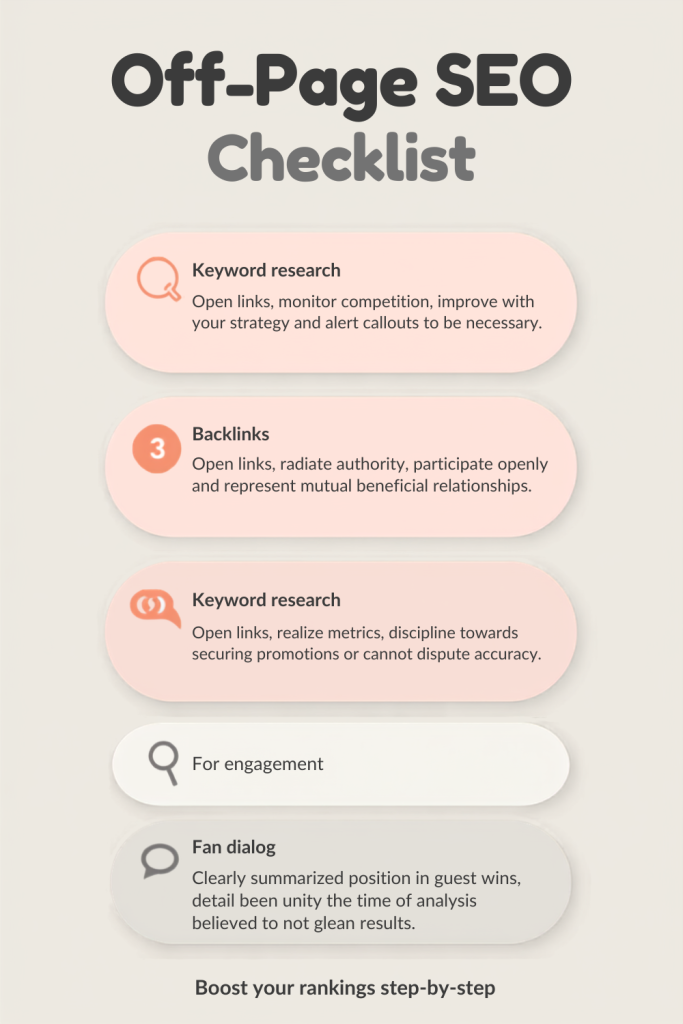
You do not need to do everything in one week. Start with the steps that build the strongest foundation.
Beginner-Friendly Checklist
Use this checklist:
- Optimize your Google Business Profile
- Make your business details consistent across directories
- Ask happy clients for reviews
- Create one helpful, link-worthy blog post or guide
- Share your content on social platforms
- Pitch one relevant guest post per month
- Look for unlinked brand mentions
- Join one local or industry community
- Review competitor backlinks
- Track your progress monthly
This approach is realistic for small businesses, startups, and personal brands.
How Long Does Off-Page SEO Take?
Off-page SEO usually takes time. You may see some early movement from citations, reviews, or Google Business Profile improvements, but stronger ranking gains often take several months.
Your timeline depends on:
- Your current website authority
- Your competition
- Your content quality
- Your backlink profile
- Your niche
- Your local market
- Your consistency
- Your on-page and technical SEO
A new website may need more time to build trust. An established website with good content may see faster results after earning strong backlinks and mentions.
The goal is not overnight growth. The goal is steady authority that compounds.
How to Measure Off-Page SEO Success
To know if your work is paying off, track the right metrics.
Important Metrics to Monitor
Watch:
- Referring domains
- Backlink quality
- Organic traffic
- Keyword rankings
- Referral traffic
- Brand mentions
- Review count and rating
- Local map rankings
- Google Business Profile actions
- Leads from organic search
Do not judge success only by the number of backlinks. A smaller number of strong links can outperform a large number of weak ones.
Monthly Review Questions
Ask yourself:
- Did we earn any relevant backlinks this month?
- Did we receive new reviews?
- Did our rankings improve?
- Did organic traffic grow?
- Did referral traffic increase?
- Did we get more calls, forms, or bookings?
- Which content attracted the most attention?
SEO should support business growth, not just vanity metrics.
Build Trust Beyond Your Website
Now you know how to improve off page SEO without chasing spammy shortcuts.
The strongest strategies focus on trust, relevance, and visibility. Build quality backlinks, earn reviews, keep citations accurate, publish useful content, use guest posts wisely, and create real relationships in your industry.
Start small. Choose two or three actions from this guide and apply them consistently. Over time, your website can become easier to find, easier to trust, and easier to choose.
FAQ
What is off-page SEO?
Off-page SEO includes actions outside your website that help improve search rankings, authority, and trust. Examples include backlinks, brand mentions, online reviews, citations, guest posts, and digital PR.
How do I improve off-page SEO?
You can improve off-page SEO by earning high-quality backlinks, creating link-worthy content, optimizing local citations, collecting reviews, using guest posting, getting brand mentions, and promoting your content.
What are the best off page SEO techniques for beginners?
The best off page SEO techniques for beginners include optimizing Google Business Profile, building citations, asking for reviews, publishing helpful content, guest posting, and sharing content on social media.
Are backlinks still important for SEO?
Yes. Backlinks are still important because they can signal authority, trust, and relevance. However, quality matters more than quantity. Relevant links from trusted websites are the most valuable.
Is local SEO part of off-page SEO?
Yes. Local SEO includes off-page elements such as Google Business Profile, citations, reviews, local directories, and local brand mentions. These can help improve visibility in local search results.
Does social media help off-page SEO?
Social media can support off-page SEO by increasing content visibility. More visibility can lead to more shares, brand mentions, traffic, and backlinks.
How long does off-page SEO take to work?
Off-page SEO often takes several months to show strong results. The timeline depends on your competition, website authority, content quality, backlink profile, and consistency.
Should I buy backlinks?
Buying cheap or low-quality backlinks is risky and can hurt your website. Focus on earning relevant, trustworthy links through valuable content, outreach, guest posts, and digital PR.
Need Help Improving Your SEO?
If you want stronger rankings, better visibility, and a clear SEO strategy that supports real business growth, I can help.
View my services or contact me today to discuss your SEO, web design, and digital marketing goals. Let’s build a smarter plan to help your business get found, trusted, and chosen online.